

Why Overlay Companies Owe Their Customers an Apology

The real, unfiltered truth about concrete overlays: what they promise, what they actually deliver, and why thousands of homeowners in the Northeast end up right back where they started.

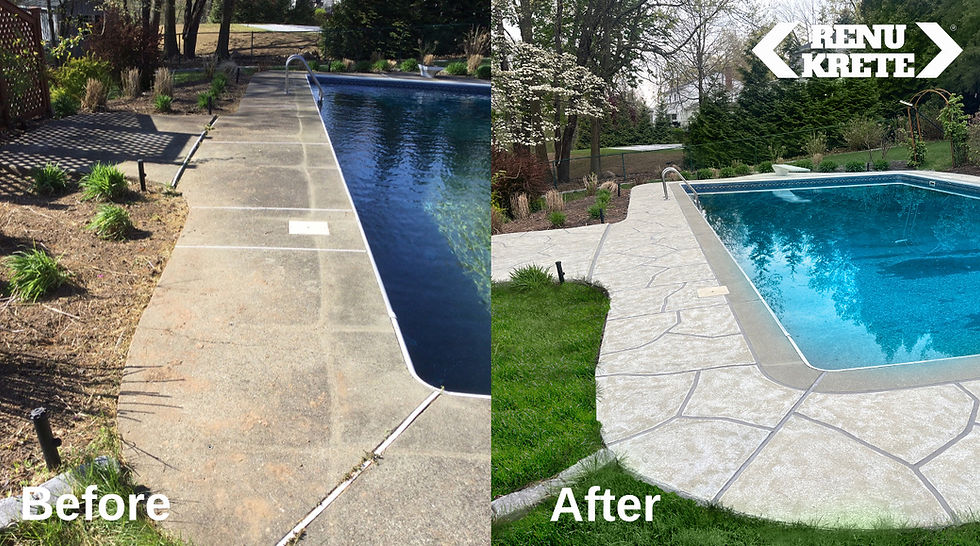
This isn't an overlay. Want a pool deck that looks like this? Keep reading.
Picture this scene. A concrete pool deck that has seen better days.
Maybe it's cracked in a few places. Maybe it has gone rough and dull, looking more like a parking lot than the backyard that was originally envisioned. Maybe there's a crack the owner has been meaning to deal with for the last three summers.
Eventually, enough is enough. Research begins.
Pretty quickly, the term "concrete overlay" comes up. The overlay company's website makes it sound straightforward: a new surface on top of existing concrete, done in a couple of days. It won't look amazing, but it will be better than what's there.
A contract gets signed. The overlay goes down. It looks cleaner than what was there before. The homeowner thinks: fine, that'll do.
And then winter comes.
By the following spring, there are bubbling edges, hairline cracks working their way up from the old slab below, and patches where the overlay is literally peeling away. Maybe the overlay company comes back to patch it. Maybe they don't. But a patch job here and there won't solve the underlying issue. What's actually needed is something that works from the ground up, not a coating on top of a problem.
This is the story of homeowners across New Jersey, Connecticut, Pennsylvania, New York, Massachusetts, Rhode Island, New Hampshire, and Maryland. It's a story we at RenuKrete have watched repeat itself season after season, year after year, while homeowners are left frustrated, out of pocket, and still dealing with a deck that never got a real solution.
So today, we're laying out the full truth about concrete overlays: what they are, why they fail, and why RenuKrete exists specifically to offer a better answer.
One that actually lasts.

First, Let's Talk About What an Overlay Actually Is
The word "overlay" sounds sturdy. Substantial. Like something that's going to hold up. In reality, an overlay is a thin layer of material applied directly over an existing concrete surface, typically between an eighth of an inch and a quarter of an inch thick. Most are cement-based mixes, though some systems use epoxy, rubberized, or polymer-modified coatings designed to bond to the slab below.
That's it. It's a coating. A skin. Roughly the thickness of three or four pennies stacked on top of each other, stretched across an entire pool deck. That layer is sometimes blended with polymers, acrylic compounds, or other "performance" additives. Overlay installers will often present these with confidence, using words like "flexible" or "reinforced" or "built for outdoor use." Those additives do help, a little. But they can't solve the fundamental physics problem:
The overlay and the concrete slab underneath it are two completely different materials with two completely different thermal expansion rates. When temperatures rise and fall, and in the Northeast, they rise and fall hard, these materials don't move together. They fight each other. And in that fight, the overlay always loses.
This is the core issue. Everything that follows, the cracking, the peeling, the bubbling, flows directly from this unavoidable reality.

The Northeast is Particularly Unforgiving
Overlays work better down South. In Florida, Texas, and Arizona, where temperatures stay relatively consistent year-round, overlays face far less stress. The thermal cycling is gentler. The concrete doesn't heave and contract the way it does up here. Overlays can last longer in those environments. The Northeast is a completely different set of conditions.
Here, the full climate gauntlet shows up every year:
Scorching July heat where surface concrete temps can exceed 120°F in direct sun, followed by January cold snaps that drop well below zero.
Freeze-thaw cycles; sometimes multiple times in a single week during those ambiguous stretches in February and March.
Ice, snow, road salt tracking onto the deck, and powerful spring rainstorms pushing water into every microscopic gap.
Every one of those events is a stress test for an overlay. And each stress test leaves a little more damage behind.

What Freeze-Thaw Cycles Actually Do
Concrete and the overlay bonded to it are two different materials, and they don't respond to temperature the same way. When the temperature swings, each layer expands and contracts at its own rate, pulling against the bond that holds them together. This never stops. Season after season, day to night, the two materials are quietly working against each other.
Now imagine that stress concentrated at the microscopic bond layer between the overlay and the concrete below. That bond, however strong when it was applied, is being pried apart from underneath with every temperature swing.
Overlays can work well in the right conditions. Controlled indoor environments like cafes, showrooms, or retail spaces, or in southern climates where freeze-thaw cycles aren't part of the equation. But when a pool deck sits in a region with real Northeast winters, it's a different story. Once even a minuscule section detaches, the damage accelerates. The delamination spreads outward beneath a surface that still looks perfectly intact. It doesn't announce itself.
By the time there's a hollow sound underfoot, a crack at a seam, or a piece that lifts right off when a bare foot lands on it, the failure has already been spreading for months. What was once a repairable issue has become a costly tear-out.

How the Existing Slab and the Overlay Become Enemies
Here's something companies who sell overlays are not always upfront about: if an existing concrete deck has even minor cracks, hairline fractures, control joint issues, or other small flaws, the overlay will not hide them. It will inherit them.
This is called crack reflection, and it's one of the most frustrating outcomes for overlay customers. The underlying concrete shifts, even slightly. Maybe a slab settles a millimeter or two. The overlay bonded to the top of that slab has no choice but to move with it.
The crack below translates directly through the overlay above. The result is a fresh surface with the exact same cracks that started the project, now sitting in the middle of whatever new pattern was just paid for.
There's also the issue of control joints, those lines cut into the concrete to give it room to expand. Overlays frequently fail at those joints first, because that's exactly where the concrete is designed to move. Applying an overlay over a deck with obvious control joints is like painting over a crack and calling it a repair.

Let's Also Be Honest About What Overlays Really Look Like
Most of this article has been about durability, because that's where overlays fail most obviously and most expensively. But there's another issue worth talking about: the look itself.
Overlays don't look great. They look alright when freshly installed: the surface is clean, the pattern is defined, it's definitely an improvement over rough, cracked concrete. But that's about the ceiling of what they offer. Most people who look at a stamped overlay can immediately sense something is off, even if they can't pinpoint exactly what.
Part of it is the uniformity. Overlays are stamped from molds, which means the pattern repeats across the entire deck in the same way, at the same depth. Natural stone doesn't work like that. Flagstone and slate have irregular shapes, varying depth, and color that shifts from piece to piece. An overlay can't replicate that. It reads as manufactured, because it is.
Part of it is the surface texture. Overlays sit on top of the concrete, and the texture is applied rather than carved. Walking on it doesn't feel the same as walking on stone. The color can look painted on. Many overlays are sealed on top, which adds a slightly plastic sheen in direct sunlight.
This is a limitation of the technology, not the installer. A thin cement coating can't convincingly impersonate natural stone. Nobody walks onto a freshly stamped overlay deck and thinks they're looking at real flagstone. Most people think it looks like a pattern on concrete. Because that is exactly what it is.

What About Painted Concrete and DIY Options?
While on the subject of concrete pool deck fixes that seem affordable but usually disappoint, it's worth briefly covering concrete paint and DIY resurface kits.
Concrete paint is accessible, cheap, and easy to apply. For a garage floor or basement it can be fine for a few years. For a pool deck in the Northeast, it's not a serious option. Pool decks take UV exposure, chlorine, summer heat, and the same freeze-thaw punishment that destroys overlays. Concrete paint, an even thinner and weaker coating, will peel and flake within one or two seasons.And once it's on there, removing it cleanly requires abrasive grinding.
DIY resurfacing kits from the hardware store or online deserve the same skepticism. The instructions make the process sound manageable, but proper surface preparation is the most critical step in any concrete restoration; and it requires professional equipment to do correctly. Without professional help, even a decent product fails early. We've met plenty of homeowners who spent a weekend on one of these kits and ended up with a surface that was worse than what they started with.

A Real New Jersey Project: What Overlay Failure Actually Looks Like
The homeowner's name has been changed. The project details are real.
We were called to a property in New Jersey, a high-end home, pool deck in serious trouble. The homeowner, who we'll call Richard, had KoolDeck installed on the deck roughly eight to ten years earlier. At the time, it seemed like a reasonable solution. The deck looked acceptable when it was new. Not remarkable, but acceptable.
By the time Richard called us, it was a different story. The KoolDeck had chipped and delaminated across the entire surface. It had the failure pattern we see constantly in the Northeast. Not a question of if. A question of when.
Before we could do anything, we had to spend an enormous amount of time grinding the failed KoolDeck completely off the slab. The process generates massive amounts of dust and debris. It all gets thrown away. It is genuinely unfortunate, a significant amount of material, labor, and cost that went into the original installation, all of it now waste. But it is unavoidable if the goal is a real, long-term result rather than another temporary layer on top of a problem.
Once the concrete was exposed and properly prepared, we sculpted it by hand into the look of natural stone using our Granite Slate color theme. The difference was immediate. Where the KoolDeck had looked flat and manufactured, the finished RenuKrete surface had real depth, real texture, real variation.
After the first gathering at the home, Richard told us guests kept asking where he got the flagstone. Not a single person said anything about the concrete. That distinction matters more than it might seem.

We first completed this project in 2015. What you see in the after photo is seven years of use. Over that entire time, Richard called us once or twice for a simple refresh. We came, cleaned the surface, addressed minor wear, and brought it right back. That is what a long-term solution actually looks like.
So Why Does Anyone in the North East Still Sell Overlays?
It's a fair question. If overlays have all these limitations then why does the market still exist? A few reasons.
Low entry barrier. The barrier to entry is practically nonexistent. Installers don't need years of training, specialized certifications, or deep material science knowledge. Someone can watch a few videos, buy the product, and start selling themselves as a pro by next week. That's great for the person getting into the business, not so great for the homeowner trusting them with a $15,000 pool deck.
Geography plays a role. Overlays can hold up acceptably in warmer climates where the ground doesn't freeze and temperatures stay relatively stable year-round. The problem is when installers learn the trade down South, see success there, and bring those same methods and materials to the Northeast without understanding what our winters will do to them. What works in Tampa doesn't survive in New Jersey. Sometimes it is not dishonesty, just inexperience with a harsher climate.
On installation day, an overlay looks fine. The surface is clean, the edges are tight, and on a dry afternoon it photographs well enough. It's nothing that's going to stop a neighbor in their tracks; but it's new, and new looks good. Most homeowners sign off satisfied. Not blown away, but satisfied. The problem is that installation day is the best that overlay will ever look. And by the time the cracks, the discoloration, and the lifting start to show, the company that installed it is long gone.
And perhaps most importantly: lack of awareness. Until recently, the realistic options for a worn concrete pool deck were demo and repour, pavers, paint, or overlay. A lot of homeowners chose overlays by default because they didn't know there was anything else.
That last reason is exactly why RenuKrete exists.

A Fundamentally Better Approach: Sculpting the Concrete That's Already There
RenuKrete's approach starts from a completely different philosophy. We don't apply something on top of concrete and hope it holds. We work with the concrete itself.
Our crews are artisans. They work by hand, cutting, shaping, and defining the surface into formations that genuinely resemble natural stone. The lines aren't stamped from a repeating mold. They're carved. The texture is real. The depth is real. The stone shapes vary from section to section because they're cut by hand, not printed from a template.
RenuKrete is NOT an overlay. It won't chip and peel away like an overlay. It is sculpted directly from the concrete already in place, and it becomes part of it.
That distinction matters for durability. Our materials are designed to work with the slab, not against it. When temperatures rise and fall, everything moves together as a unified surface. It also means that existing cracks don't necessarily disqualify a deck. We address cracks as part of the process, incorporating them into the final result so they look intentional and beautiful.
And because no two decks are hand-sculpted the same way, every RenuKrete installation is unique. The pattern, the stone shapes, the color combination; all of it is specific to the yard and tailored to the homeowner.
What Happens When Something Needs a Fix?
This is one of the most important questions to ask before committing to any pool deck surface: what happens when something goes wrong? With an overlay that is essentially a single, cookie-cutter sheet stamped across an entire slab, the spot that failed can't just be fixed. The repair becomes a tear-out. The tear-out becomes a full redo. One problem turns into a whole new project.
Think about a roof. If a severe storm rips off a few shingles, a roofer comes, replaces those shingles, and life moves on. Now imagine if the roofer showed up and said, "Sorry, we have to tear the entire roof off and start over." Nobody would buy that roof in the first place. So why accept that for a pool deck?
RenuKrete is designed to last for decades, but pool decks live outside, and life happens. Because every RenuKrete piece is individually sculpted from the existing slab, damage can be repaired right where it occurs. One localized area. One fix. No tear-outs or starting from scratch necessary.

More Than Just a Backyard
People don't think about their pool deck in square footage, crack types, or product specs. That stuff matters, but it's not what's actually on their mind.
What they're thinking about is the summer they want to have. The first barbecue of the season. Kids running around the backyard. What it would feel like to walk out the back door on a July morning with a cup of coffee and actually be glad they did.
A crumbling, peeling pool deck doesn't just look bad, it changes how the space gets used. Gatherings drift elsewhere. The backyard that should be the center of summer starts to feel like something to apologize for. It happens gradually, and then all at once.
But the reverse happens too. When homeowners step onto a freshly finished RenuKrete deck for the first time, the entire backyard feels different. What once felt worn and overlooked suddenly feels like a resort space right outside the door. It becomes the place guests notice first, where conversations linger, where people naturally gather. The backyard stops being something to work around and becomes the center of everything again.
TThat moment doesn't come from an overlay. Overlays can never deliver that. They provide a surface that's marginally better than what was there, until it isn't.
RenuKrete offers longevity and a look that genuinely belongs in your backyard.
The Bottom Line
Concrete overlays are not the right solution for pool decks in the Northeast. They're thin, they don't look convincing, they can't handle our climate, they can't be meaningfully repaired, and when they fail (which they will), the removal can cost nearly as much as the original installation.
That's not just our opinion. It's the experience of homeowners across New Jersey, Connecticut, Pennsylvania, New York, Massachusetts, Rhode Island, New Hampshire, and Maryland. It's what pool professionals have been telling their customers for years. And it's what the physics of freeze-thaw cycles confirm every single spring.
There is a better option. One that works with the concrete instead of sitting on top of it. One that doesn't rely on a bond layer that winter will eventually pry apart. One that can handle the cracks and the settled slabs and the old control joints, and come out looking like natural stone that's been there for decades.
It's what we've been doing for years across eight Northeastern states. Today that work is reflected in a TrustScore of 4.8 across more than 350 reviews. But the real measure isn't a rating, it's when customers call us five years later not because something went wrong, but to tell us their deck still looks the way it did the day we finished it. That's the RenuKrete standard we build toward every time.

Ready to see what your pool deck can look like?
Visit renukrete.com/getstarted for a free pool deck evaluation.


Comments